Home / Journal / Can Smart Glasses Fit in the Original Case with Accessories Attached?
Journal

Can Smart Glasses Fit in the Original Case with Accessories Attached?

A case-fit guide for nose pads, temple sleeves, ear hooks, prescription inserts, light blockers, and charging cases—without forcing the lid.

Published April 03, 2026
Read time 2 min read
Updated July 29, 2026
Author SmartGlassGear Editorial

Updated July 29, 2026.

Short answer: thin prescription inserts and low-profile pads often fit, but ear hooks, temple sleeves, light blockers, cables, and clip-ons frequently need to come off. A protective case and a charging case have different tolerances. If the lid needs pressure, the temples spring open, or the charging indicator does not confirm a dock, remove the accessory.

The no-force case test

  1. Power down or follow the normal storage procedure for your model.
  2. Fold the temples without resistance. An accessory must not twist the hinge.
  3. Place the glasses in the original orientation. Do not rotate them to make an accessory fit unless the manufacturer permits it.
  4. Lower the lid using two fingers. It should close under its own normal latch force.
  5. For a charging case, confirm the manufacturer's charging indicator.
  6. Reopen the case and check for pad impressions, cable pinching, sensor contact, or lens rubbing.

Accessory-by-accessory answer

Accessory Original protective case Original charging case
Prescription insert Usually designed to remain installed Model-specific; confirm the frame seats fully
Thin silicone bridge pad Often fits if it does not move the folded frame Remove if it covers or lifts the docking contact
Temple sleeve Sometimes; watch the hinge recess Often too thick for a molded charging cradle
Ear hook Usually remove Remove
Light blocker or lens shade Usually remove unless the case explicitly has clearance Remove unless the manufacturer says otherwise
Charging cable or battery module Disconnect and store separately Never trap a cable in the lid
Sun clip Use a separate pocket if it can touch the lens Remove unless the case has a dedicated recess

Why charging cases are stricter

A charging case is a shaped dock, not simply a box. Ray-Ban Meta charges at the nose bridge and Ray-Ban says the case is the only charging method. Ray-Ban also warns against storing non-Meta glasses, including Ray-Ban Stories, inside the Meta charging case. Replacement cases are selected by model code, which is a strong sign that silhouette and contact alignment matter.

Rokid similarly sells a dedicated charging case for its current display glasses. Its ordinary storage case and charging case are separate accessories. If an add-on changes where the frame sits, the glasses may appear stored but fail to charge.

When a roomier case makes sense

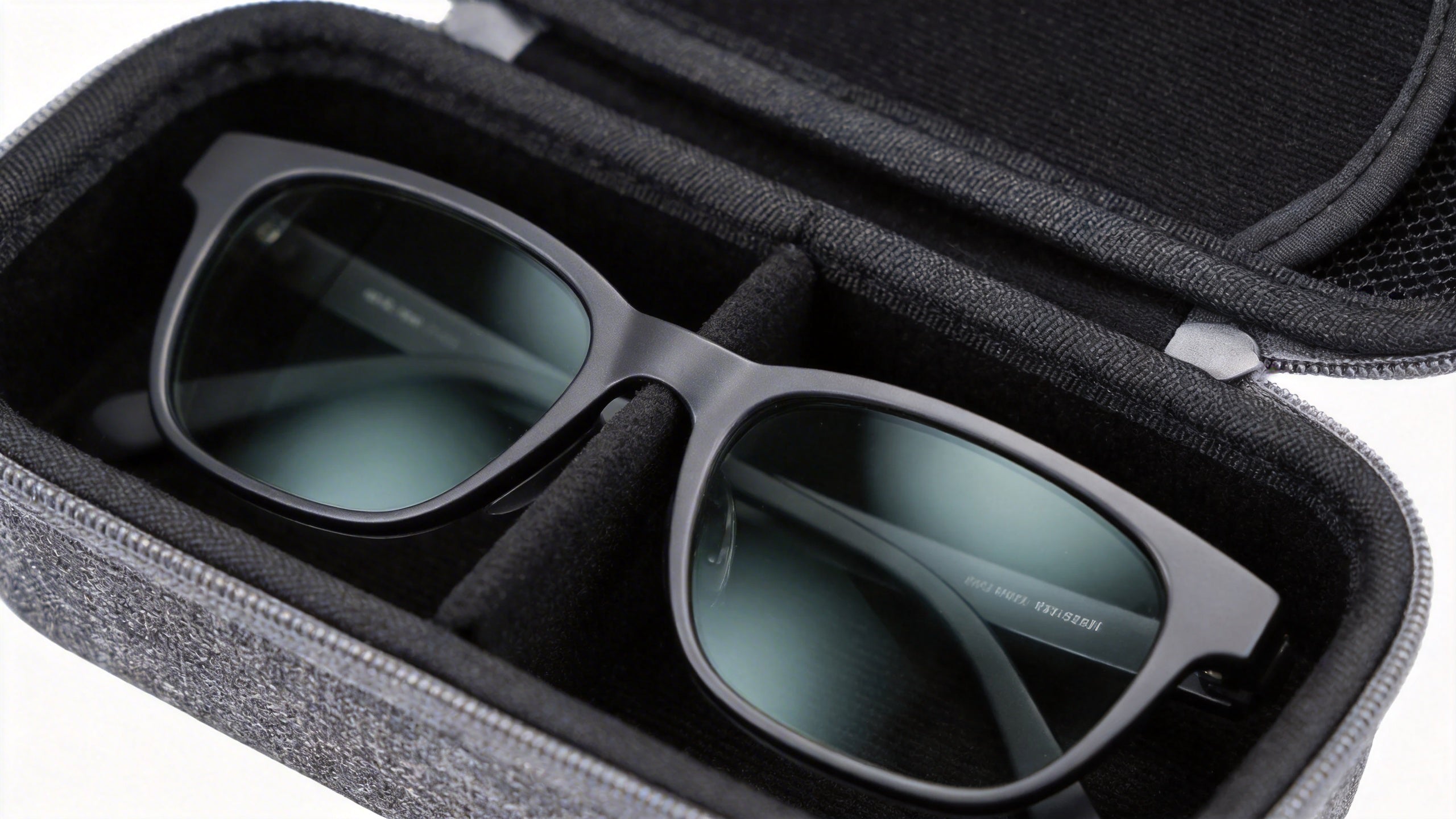
If you remove and reinstall several accessories daily, a roomier hard case can reduce friction in the routine. The SGG VAULT is sized for slim AI-style glasses such as Ray-Ban Meta and Oakley Meta; it is not our recommended case for larger display glasses such as XREAL, VITURE, or Rokid Max. Always compare the folded-frame measurements and keep hard accessories in a separate pocket so they cannot scratch the lenses.

Bottom line

“The lid closes” is not enough. It must close without pressure, preserve hinge alignment, protect the lenses, and—when applicable—confirm charging. Remove any accessory that fails one of those tests.

Manufacturer and safety sources checked

Compatibility and instructions can change. Check the manual for your exact model before modifying, cleaning, packing, or charging it.

SGG
Lead Curator

SmartGlassGear Editorial

Specializing in augmented reality ergonomics and optical clarity. Our editorial team stress-tests accessories across Meta, XREAL, and Rokid ecosystems to ensure every recommendation meets geek-level standards for daily wear.

Editorial Standards How We Evaluate